Book 2
ConcertinaLongBook 1–Unique state monotypes
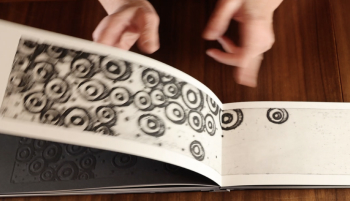
Theese are unique state monoprints created using an additive/subtractive method on 3.5-meter-long Mylar plates.
The plates are printed on 3.2-meter-long sheets of handmade Canard paper using Gamblin Portland Black mixed with Charbonnel Prussian Blue to create the velvety black colour needed for this series. Each bleed print has a finished unfolded size of approximately 300 x 26 cm’s.
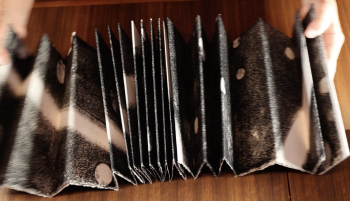
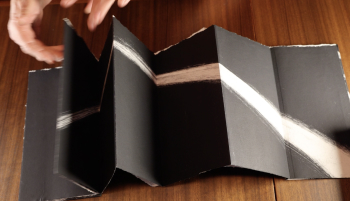
Each print was folded into a concertina, and each book comprised two prints, back to back. These prints are all similar in the story they portray, but are unique and different because of the process undertaken to create them.
The books and their respective hardcovers are approximately 27 x 11cm. The cover of these books allows them to be displayed standing up on their own.
The covers, endpapers and box linings are test prints from this series, using all acid-free archival materials.
All folding, binding and box making happened at my home studio in Erskineville.
There are four of these books available.
Press and printers
All prints were created by hand, using manual barrens, at The Sydney College of the Arts, Old Teachers College, Camperdown Campus.
Master Printer Chris Ingham provided technical support and was my co-printer for this series in January 2025.
All books were bound at my home studio and were first displayed at Sydney Contemporary 2025.
Additional notes
The paper is handmade Canard paper, made by a female maker in Montreal, Canada. The works were created on Campus during the summer break in the University’s Print Rooms. Master Printer Chris flew in for the week of printing. The prints took weeks to dry because of the amount of ink used on each of the long acetate plates and the weight of water required for successful ink uptake by the paper using a hand rolling method. Gamblin Inks were hand mixed to achieve the colour depth required. Each roll of paper–because of the process the maker takes to create it–had to be treated a little differently by way of dampness, ink use, pressure of rolling, and with the manual lifting off of paper. In some of the test prints, there were small tears–these were an unavoidable part of printing with handmade and quite unique papers. We managed to work that through the books available for acquisition are without these tears.
©2025 lisa jackson pulver
build by brandshaper.co